
In this article, we review the FiiO JH13, their latest IEM released under the Jade Audio sub-brand, currently selling for $39.99 USD.
Disclaimer: the FiiO JH13 was sent to us free of charge by FiiO, in exchange for our honest opinion.
About FiiO
Founded in 2007, FiiO has grown into one of the most recognized names in the portable audiophile space, standing alongside brands like Astell&Kern, iBasso, Meze, or HiBy. From IEMs to headphone amps, DACs, and of course DAPs, the brand has consistently delivered an impressive roster of award-winning devices like the FiiO M21, the mighty M27, or the FT1 Pro – a planar headphone priced at just $200, yet tackling headphone twice to five time more expensive.
And if the journey started out in the Chi-Fi bracket, with FiiO offering affordable yet surprisingly solid gear, the brand steadily climbed the ladder over the years. So much that it’d be hard to call them anything but Hi-Fi nowadays, with the M33 R2R bringing resistor-ladder technology to the portable world, a whole new range of desktop solution like the SP5 or K17 – expanding the brand’s footprint, and even retro products like turntables or cassette players joining the lineup.
FiiO M33 R2R Review
Yet, if that line-up already seemed pretty complete to me, FiiO still decided to create not one, but two sub-brands dedicated to more… entry level release: Jade Audio and Snowsky. And if I, personally, always had a hard time really telling the three groups apart, I have to admit that many of their creations managed – to my great surprise – to establish themselves as genuine references in my repertoire; much like the excellent FiiO FT7, we reviewed and praised.
So, when FiiO decided to release their latest IEM, the FiiO JH13, a hybrid model embedding two balanced drivers with one dynamic, for less than $40 USD, I jumped on the occasion.
The perfect match for their new Echo and Disc player ? Time to find out.
Jade Audio
As said above, unlike the M21 or the M27 previously reviewed, the FiiO JH13 isn’t part of the classic FiiO range and falls under the Jade Audio umbrella (which is different from the Snowsky one, where you’ll find the DISC, the Anytime or the ECHO).
What’s the difference between FiiO and Jade Audio? Let me quote their website:
“Jade Audio” is a subsidiary brand of FiiO Electronics Technology Co., LTD. It is a stylish, technological, and youth-oriented brand aiming to provide high-quality yet cost-effective audio products with an excellent listening experience for the younger generation all around the world.
The entity’s Chinese name is derived from “翡声” (Fei Sheng), meaning “the sound of Jade”. The name “Jade Audio” conveys our mission towards providing consumers with a crisp and pleasant listening experience while maintaining audio fidelity.
As a matter of fact, there are now quite a few Jade Audio devices, especially in the IEM department:
- FiiO JH3 : a hybrid IEM with 1DD + 2BA – the JH13’s predecessor (reviewed)
- FiiO JD1 : a single driver IEM with their new 10mm LCP diaphragm (reviewed)
- FiiO JD3 : a single dynamic driver IEM (reviewed)
- FiiO JD7 : a single dynamic driver IEM with a wood finish (reviewed)
- FiiO JT3 : a foldable, open-back, dynamic headphone with a warm signature (reviewed)
- FiiO JT7 : a planar magnetic headphone that took a lot from the FT1 Pro (reviewed)
To that, you can also add a few DAC or Amp, like the :
- FiiO Jiezi : a dongle sized DAC/Amp made for phone users (reviewed)
- FiiO KA15 : a incredibly versatile headphone DAC, mimicking a K7 player (reviewed)
- FiiO KB3 : a mechanical keyboard, embedding a real dual-DAC setup – love this one (reviewed)
Jade Audio managed to deliver some true gems – the JT7 and KA15 being prime examples – so let’s hope that the FiiO JH13 does even better.
FiiO Jade Audio JH13
Design
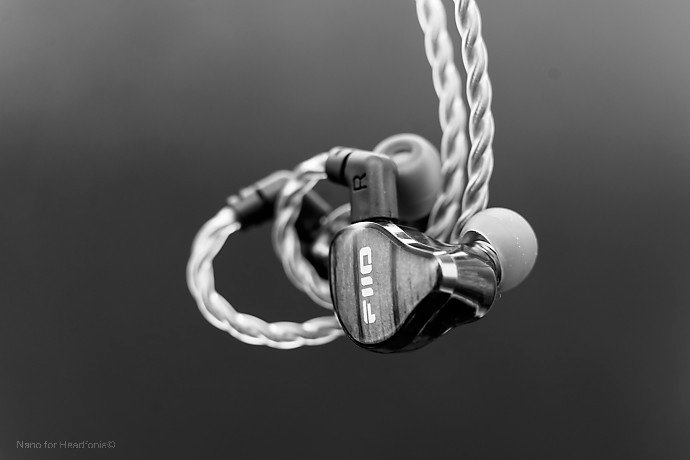
Like the JH3 before, the FiiO JH13 went for a very classic design, combining semi-clear, black-tinted glossy plastic, with a custom faceplate – this time made of wood, when the previous one was made of aluminum.
Nothing fancy of course – still at $40 IEM – but nothing bad either, each unit sporting a genuine zebrawood faceplate, with naturally formed, interwoven light and dark stripes, outlining the fact that each model will display their own, and unique, pattern. A nice touch, one that adds a touch of warmth and personality, that plastic alone simply couldn’t deliver.
Shape-wise, the JH13 follows a fairly standard IEM ergonomic template. Compact enough to sit flush in most ears, with an around-the-ear cable design holding them steady on the go, while reducing microphonics. Note that like all of Jade Audio IEMS, the JH13 was given two-pin connectors instead of MMCX one, some will prefer, other won’t, but that also mean easier and cheaper to find after-market cables.
Overall, the design language stays firmly in budget IEM territory. No CNC-machined titanium like the Meze Astru, no exotic finishes – just clean plastic work with that zebrawood accent doing the heavy lifting visually – no complicated design. But, for $40? That was expected, and FiiO clearly chose to put the budget toward drivers rather than premium shell materials – which is kind of a clever choice if you ask me.

Build Quality
As usual with the brand, build quality is surprisingly good for the price.
Plastic shells feel light but never flimsy and, if the FiiO JH13 remain one of the most affordable IEM the brand has to offer, they don’t feel like a cheap knock-off you’d buy in an airport lounge. No steps, no cracks, no bruises, just one smooth surface all over the shell, perfectly balanced in hand, magnified by the lovely wooden faceplate and emblazoned FiiO / Jade Audio logo – both imprinted on each side of the ears.
Even better, instead of the classic plastic nozzle, FiiO fitted metallic one for this model. A small touch, but a very appreciated one, those copper-looking tube proving to be sturdier on the long run. Add to that a thicker lid for the silicon tips, raised 2-pin connector for the cables and you’re good to go!
Last but not least, let’s talk about the cable. Out of the box, the JH13 ships with a four-core, spirally braided high-purity oxygen-free copper cable – 120 wires across four strands – terminated with a 3.5mm plug. A good, supple cable, that fit perfectly for that IEM – the braiding offering the perfect balance of sturdiness and lightness – but may feel a bit too rigid around the earloop. But maybe that’s just me nit-picking.
So far so good, so let’s check what’s inside the box.

Sound
For this review, my main sources were the FiiO DISC, the Topping DX1 II (review incoming) and the Fosi ZH3. The FiiO Echo Mini also proved to be a simple and effective combo with the JH13, but more on that later
Files were played from either Apple Music (Hi-Res when available) / Spotify Lossless or my own local library via Plex. Some tracks will be highlighted, just so you can try them at home too!
Overall Signature
Last time, I was genuinely surprised by the JH3 – a small hybrid IEM that punched well above its price. And the FiiO JH13, its direct successor, tried to pull the exact same trick – with mixed results.
Right off the bat, the V-shaped signature made itself very clear. Bass and treble were both pushed forward, while vocals took a noticeable step back. Not a subtle V either – on vocal-heavy tracks, the recession became quite apparent, the midrange sounding somewhat hollow against the sheer weight of the lows and the sparkle of the highs. A tuning that won’t bother electronic or hip-hop listeners, but one that vocal-centric audiophiles might struggle with.
Bass hit hard and sat at the front of the mix, while treble got a slight push that added sparkle and airiness to the top end. The midrange, predictably, took a back seat; not absent, but clearly not the priority here. For a hybrid IEM packing one dynamic driver handling the lows and two balanced armatures managing the highs, this kind of make sense – each driver type playing to its strengths, and FiiO’s crossover doing a reasonable job keeping things coherent.

Where the JH13 fell short, however, was soundstage. Narrower than I anticipated, and quite far from what you’d get with a 100% dynamic driver IEM like the FD3 Pro. Imaging stayed adequate, separation was fine on moderately busy tracks, but that sense of openness and air the JH3 managed to hint at? Not quite there. Instead, the JH13 created more of a “sound bubble” effect – intimate, focused, almost cocoon-like – which, on ambient tracks especially, actually worked in its favor. Less space, more immersion. An interesting trade-off.
The treble boost added presence and detail without tipping into harshness, and even during longer sessions, sibilance wasn’t an issue. The balanced armature pair handling the upper frequencies seemed well-tuned for this price bracket – not the most refined or extended, but competent and controlled.
A double-edged sword really and I’m sure that some of you will like that signature, the JH13 delivering a sense of precision and bite that gave transients extra definition; while on the other, sensitive listeners might find that top end a tad too aggressive on certain recordings. FiiO being FiiO, the tuning felt deliberate rather than accidental – a calculated push for clarity over smoothness.

That said, taken for what it is – a $40 hybrid – the overall rendering impressed me more than I expected. The presentation came across as surprisingly dry and controlled, with well-managed transients and a tonal balance that, if you set the V-shape aside, felt coherent across the board. Now, let’s be realistic, you’re not buying a technical marvel. Detail retrieval stayed adequate, transient response was acceptable, and the overall resolution reminded me of exactly what this is – an entry-level hybrid that prioritizes finesse, but with clear technical limitation. Compared to some of the chi-fi competition in the same bracket, the JH13 held its own, but I have a feeling there are options out there that might edge it out in terms of raw technicalities.
Source pairing played a significant role too. Plugged into the new Topping DX1 II, the JH13 immediately came alive – the little DAC managing to extract the best out of the IEM, tightening up the low end and adding a bit of control to the overall presentation. Same went for the FiiO DISC, which matched surprisingly well, especially on bass-heavy tracks where the two seemed to complement each other almost naturally. Paired with the FiiO Jiezi though, things weren’t as good, and the duo sounded more like a mushy pair, which came as a big deception for me.
So, is the FiiO JH13 the best IEM I’ve tested at this price? Frankly, no. There are chi-fi options out there that might edge it out in terms of raw technicalities and midrange presence. Is it a bad IEM then? Far from it! And, properly driven with the right source, the JH13 proved to be a fun, engaging, and surprisingly competent IEM, one that could easily fit in a bag as a spare pair. Not a revolution, but a solid effort from the Jade Audio team.

Tonality
Highs: present and precise, borderline sharp. Treble got a deliberate push from FiiO, and it showed: around 8kHz, the JH13 sat right on the edge – enough presence to deliver a sense of bite and definition on cymbals and hi-hats, without quite tipping into sibilance. Extension was decent for the price, giving electronic tracks in particular an extra layer of energy and sparkle but, paired with an overly bright source, that top end sometimes turn a bit aggressive – so pairing really matters here. A tuning that rewards careful matching, but one that ultimately favored precision over comfort.
Good test track: Savant – Encore
Mids: clean but recessed. As expected from a V-shaped signature, the midrange sat behind the bass and treble in the overall mix. On vocal-heavy tracks, the recession became particularly apparent – female voices losing some of their body and warmth, male voices occasionally feeling distant in busier arrangements. That said, the balanced armatures still managed to keep things intelligible and reasonably textured; vocals never disappeared entirely, they just weren’t the star of the show. Proof that V-shaped doesn’t necessarily mean bad mids – just not the focus.
Good test track: Corinne Bailey Rae – Breathless
Bass: big, punchy, and deeply addictive. Clearly where FiiO spent most of its tuning budget, and – in my opinion – that paid off. The 10mm dynamic driver pushes bass hard, with sub-bass extension that gave electronic and ambient tracks a satisfying rumble, and mid-bass punch that kept percussion lively and engaging. On ambient tracks especially, the narrow soundstage worked in the JH13’s favor – creating that cocoon-like immersion effect I mentioned earlier, wrapping the listener in a warm, enveloping low-end. Control stayed reasonable for the price; not the tightest bass you’ll ever hear, but far from sloppy, with enough texture to keep things interesting on well-produced tracks. The more you push, the more the JH13 rewards you.
Good test track: Alott – Let You Go

Sensitivity / Hiss
Impedance is very low (24ohms), sensitivity is good (110dB/mW), so you should have no problem driving those IEMs with your usual DAP, even your phone.
On my FiiO KA15, with a set of FiiO cables, the IEM behaves exceptionally well. Same with my ddHiFi TC35C or even plugged into my computer with the default cable, all were able to drive the IEM with ease, even in noisy environments.
Last but not least, hiss never was an issue.
The FiiO Jade Audio JH13 article continues on Page two, after the click here, or after the jump.
creditSource link