

Over the past years, audio companies have showcased countless true wireless earbuds and IEMs that keep outdoing each other. Sennheiser, Sony, Beyerdynamic, JBL: all these brands have created excellent true wireless listening experiences for everyday use. But how about for the audiophile looking for the best of the best?
Two brands that make very high-quality devices are Noble Audio and Bowers & Wilkins. Their flagship models are excellent examples of hi-fi listening and accessible features made into one portable system. The Noble FoKus Prestige Encore is the latest from Noble Audio and has made waves as one of the best true wireless IEMs on the market. The Bowers & Wilkins Pi8 is the newest upgrade from the Pi7 S2, which was given its flowers and still continues to get praise many months after its release.
So if you’re looking for a hi-fi upgrade, which one do you choose? Their price points are quite different – $699 and $499, respectively – so it’s important to see what makes these flagships so different. In this review, we compare everything from sound profile to included features to see which one is right for you.
WHAT COMES IN THE BOX
NOBLE FOKUS PRESTIGE ENCORE
- Noble Audio FoKus Prestige Encore
- Charging Case
- USB-C Charging Cable
- Assorted Eartips
- Small Drawstring Carrying Bag
BOWERS & WILKINS PI8
- Pi8 True Wireless Earbuds
- Extra Small / Small / Medium / Large ear tips
- 60 cm USB-C to USB-C charging cable
- 80 cm 3.5 mm jack to USB-C audio cable
DESIGN & BUILD QUALITY
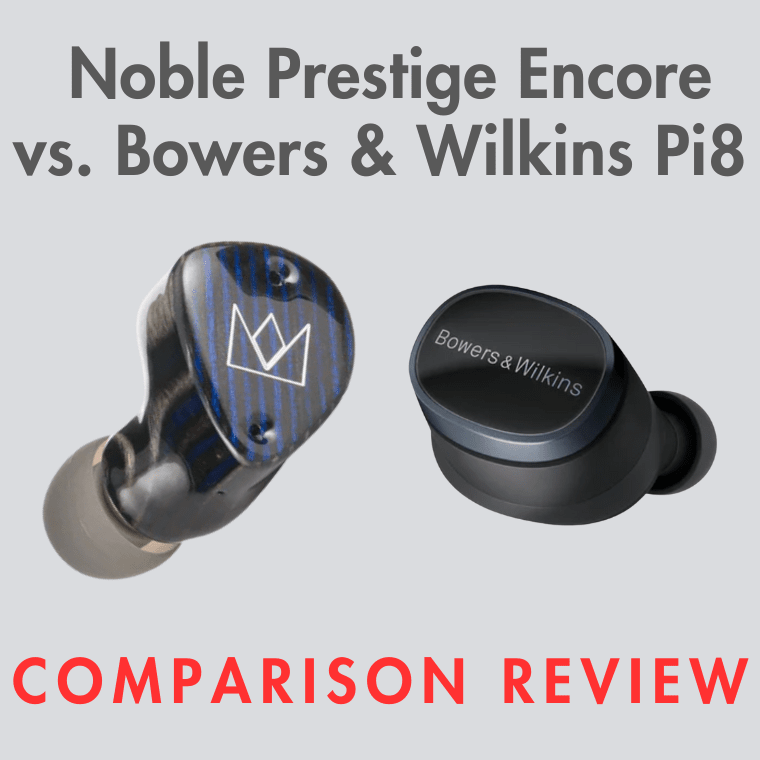
Right off the bat, you can tell these earbuds look almost completely different. The Noble Prestige Encore is a bulkier earbud that resembles the in-ear monitors for which Noble Audio is known. It’s a very luxurious fit and has some weight to it, making it seem more high-quality just by the feel in your hand. The Pi8 is a lot smaller, looking more like a classic earbud that fits perfectly inside the ear with no issue. It is definitely more lightweight and a subtler aesthetic than the Prestige Encore, but it still shines and has a clean finish to look polished and high-end. Based on the design alone, you can see that the Prestige Encore is a more delicate IEM and is mainly meant for office or home use, or some light travel. If you are looking for a more versatile option that can be used for working out just as much as daily commuting or office use, the Pi8 is a better choice.
The Prestige Encore only comes in its signature dark blue, and the wood finish has touches of grey and black. Each unit of the Prestige Encore has a slightly different finish on the housing since it is made from lacquered wood, but they all shine the same way. Meanwhile, the Pi8 comes in the same basic shape with different color options. You can get anthracite black, dove white, midnight blue, or jade green.
FEATURES & FUNCTIONALITY
Both the Pi8 and the Prestige Encore have simple functionality when you start to use them. Pairing is easy on each device, though the setup is slightly different. The Noble Prestige starts its pairing inside the case, with a handy button to press on the inside to turn the device on. On the other hand, the Pi8 has sensors that need to be held to turn on pairing mode. This invites more room for technical error, but the process was smooth and hassle-free during my testing. The Pi8 also has the option of a wired connection, so you can connect the case via a 3.5mm cable to your audio source, then use the earbuds wirelessly connected to the case. It’s a way to bypass the Bluetooth if the connection is unstable or your device doesn’t allow for Bluetooth pairing.
When it comes to features, the two earbuds impress with a lot of different customization options. Both the Prestige Encore and the Pi8 come with active noise cancellation, EQ customization, and multi-point connection. The Prestige Encore’s features were a big selling point, especially since Noble’s previous flagship did not come with as many features as this one. The EQ customization in the Prestige Encore is very exact and allows you to presave custom filters or just use the stock ones. The Pi8 gives you a 5-band EQ to use that is just as useful, and the changes can be saved as preset filters.
During playback, both earbuds performed exceptionally well. Using the touch sensors on each side was easy and useful, as they were sensitive to respond to the touch but not so sensitive that they activated at each small adjustment. Both the Pi8 and the Prestige Encore allowed me to choose what I wanted each side to do, and it allowed me to customize my controls based on my listening. The active noise cancellation was strong on each and immersed me in my listening, as well as blocked out any outside noise with ease. I found the noise cancellation to be stronger on the Prestige Encore as opposed to the Pi8, mainly because of the better in-ear seal that added onto the noise cancellation feature.
PHOTO GALLERY
TECHNICAL SPECIFICATIONS
NOBLE FOKUS PRESTIGE ENCORE
-
Driver system:
- 1 × 8mm Dynamic
- 2 × Balanced Armature
- 1 × 6mm Planar Magnetic
- Chipset: Qualcomm® QCC3091
- Bluetooth: 5.4 with TrueWireless Mirroring and multipoint support
- Codecs: aptX Lossless, aptX Adaptive, LDAC, AAC, SBC
- Noise control: Hybrid Active Noise Cancelling + HearThrough mode
- Calls: Dual-mic cVc™ noise suppression
- Battery life: 10h (ANC off) / 7h (ANC on), up to 35h total with case
- Charging: USB-C + Qi wireless charging; 10min quick charge = 2h playback
- Design: Smaller housings, triple-vented metal nozzle, refined wood finish
- Personalisation: Audiodo per-ear calibration with on-device storage
- App: Custom EQ, touch mapping, OTA updates, multilingual interface
BOWERS & WILKINS PI8
- Wearing Style: In-Ear Noise-Cancelling True Wireless Earbuds
-
Technical Features:
- High-performance DSP with dedicated DSP and amplifier/DAC
- True 24-bit audio connection
- 5-band customisable EQ + TrueSound™ mode
- Bluetooth 5.4 with aptX™ Lossless technology
- Multipoint connectivity
- Active Noise Cancellation (ANC)
- Audio retransmission from charging case (aptX™ Adaptive)
- Wireless and USB-C charging
- Fast charging support
- Apple MFi Made for iPhone support
-
Bluetooth Codecs:
- aptX™ Lossless
- aptX™ Adaptive
- aptX™ Classic
- AAC
- SBC
- Drive Units: 12 mm Carbon Cone
- Microphones: 3 per earbud for telephony and ANC
- Battery Type: Rechargeable Lithium-ion (earbuds and charging case)
-
Battery Life & Charging:
- Up to 6.5 hours for earbuds (with ANC on)
- Additional 13.5 hours from charging case
- Charge time: 2 hours
- 15-minute charge = 2 hours playback
- Wireless Charging Support: Yes
- Water Resistance: IP54 (earbuds)
-
Audio Inputs:
- Earbuds: Bluetooth
- Charging case: USB-C & 3.5 mm analogue jack (wireless audio retransmission via charging case)
LISTENING REVIEW
SOUNDSTAGE & IMAGING
Now we move on to the listening. Sonically, there were a lot of similarities between the Prestige Encore and the Pi8, but also enough differences to really tell them apart. In their soundstages, the Prestige Encore has a vastly wider image than the Pi8. It expands further horizontally to create a more immersive signature that has excellent depth. The Pi8, alternatively, still has a wide soundstage, but it is noticeably narrower than something like the Prestige Encore. It has excellent height, and the depth creates very clear layers to distinguish instruments. Both have excellent detail that makes sure you can analytically listen just as much as casually listen.
In terms of their sound signatures, they both impress with good sound reproduction that makes instruments have their natural and recognizable timbres. In the overall picture, the Prestige Encore is a bit more balanced between the highs and lows than the Pi8 is. Bowers & Wilkins is known for having quite bass-heavy signatures, and the Pi8 falls right into that. However, it does have a nice treble to balance it out just enough from becoming overwhelming.
For a smoother out-of-the-box sound, the Prestige Encore is a top contender and will be tough to beat. While the dynamics in the Pi8 impress, you’ll need to use the Bowers & Wilkins app to adjust some of the tuning to get to the same balanced sound. If you’re a fan of heavy bass, the standard tuning on these earphones will be great for you.
BASS FREQUENCIES
The bass in both the Prestige Encore and the Pi8 is impactful and driving. I appreciated how each bass response remained controlled and direct, and neither got overwhelming to take up more space than necessary. I found that the Prestige Encore had a tighter bass than the Pi8, and it stayed separated nicely from other elements, so it could take on a character of its own. The bass has a colorful and thick body that complements the other ranges nicely, and still doesn’t hide behind anything else to make it lose power. It balanced well with the treble end, so it doesn’t take over the whole signature but still makes a statement in any track.
The Pi8 has a bass response that is much more powerful and has a stronger overall response. It doesn’t have the same refinement as something like the Prestige Encore, but it definitely has the same detail and punch in a more forward way. It is a particularly thick bass response that gets a lot of body in bass-heavy genres. The noise cancellation is effective in making the bass response even stronger. If you’re looking for a subtler bass response, you won’t find it in the Pi8, but it’s easy to tune the bass to your liking with the Bowers & Wilkins app. The color and power from the bass in the Pi8 is great for driving genres like EDM or pop.
MIDRANGE FREQUENCIES
The midrange on both of these earbuds was impressive with detail and layering. I found the Prestige Encore to really show off its wide soundstage here, where all the elements could expand outward and be distinctly separated. The detail produced in the midrange of the Prestige Encore is unlike anything I’ve heard previously in a true wireless experience, and I have to applaud the attention to the minute elements I could hear and appreciate in all my favorite tracks. Instrumental timbres sounded natural and like they were being played right in front of me. There was an ultra-clear response in the midrange that made the Prestige Encore take on an almost transparent quality, but it was more than welcome to make things a little less reference and more fun.
The Pi8, on the other hand, takes the midrange and makes sure you can hear every element. Instead of things filtering too far backwards, you get to hear a great amount of detail front and center. When elements get placed in spaces other than directly in front, you get a good amount of height from other elements to create this wall of sound in front of you. One element that the midrange of the Pi8 does incredibly well is the vocal reproduction. It sounds like the singers are directly in front of you and are the spotlight of any track. The Prestige does this as well, but there is more forwardness in the Pi8 to make it more effective.
TREBLE FREQUENCIES
In terms of treble response, this is where both the Encore and the Pi8 get most of their detail. The Encore has a strong treble range that shows even the most minute details. The balance in this signature comes from the treble and bass being on par with one another, both in power and detail. The top end has a lot of space to make the Encore seem much more open than other true wireless earphones, so the sound is less fatiguing and easy to listen to for long periods of time. The Encore did not sound compressed or caged in, thanks to the openness in the treble range. You could appreciate the detail in all frequency ranges based on the way the treble carried itself throughout the signature, highlighting minute elements in timbres and maintaining clarity.
The Pi8 has a similar response in that you get very precise detail in the treble. You can hear how the top end opens up to give you more detail and balance in the entire signature. The Pi8 doesn’t have as sharp or precise a midrange as the Prestige Encore, but it does retain a lot of detail that carries through each range. The treble was slightly more recessed, especially compared to the bass response. If you tuned down the bass, the treble balances out the low perfectly. If not, the treble has to fight a bit more for it to take up space in the signature. For people who want more balance in their listening, the Encore may give you the sound you’re looking for without the need for adjustment.
FINAL THOUGHTS: ENCORE OR PI8?
Looking at all these qualities side by side, you’ll see that the Noble Audio Prestige Encore and the Bowers & Wilkins Pi8 are two excellent choices for true wireless in-ear monitors. The Prestige Encore is definitely a flagship model with features to boot, though it’s more delicate than most other true wireless IEMs you’ll come across. Bassheads will love the Pi8, where the low end is the most prominent part of the sound signature. It also has full customizable features, and can be worn as a daily driver wth no issue.
At the end of the day, the choice between the Encore and Pi8 will come down to what you prefer in a true wireless IEM. If you want the best of the best, the Prestige Encore is for you. If you’re trying to be price-conscious and want something with more durability, the Pi8 may be a better option.
Try out both the Prestige Encore and the Pi8 at Audio46 to decide which is best for you.
QUICK SUMMARY
Noble FoKus Prestige Encore Price: $699 // Bowers & Wilkins Pi8 Price: $499
Both earphones are true wireless via Bluetooth, with active noise cancelling and customizable features.
Prestige Encore is a bulkier IEM and a bit more delicate; Pi8 can be used for more everyday activities.
Sound quality is stellar and precise on both: the Encore has a bit more balance, and the Pi8 has more bass.
OTHER COMPARISON REVIEWS
creditSource link