
Louis reviews the Questyle SIGMA Pro, a flagship portable Bluetooth-capable DAC and Current Mode discrete engineered headphone amplifier. It is currently priced at $899.00.
Disclaimer: I received this sample in exchange for my honest opinion. Headfonics is an independent website with no affiliate links or status. I thank Questyle for this opportunity.
Click here to read more about the Questyle products previously reviewed on Headfonics.
This article follows our current scoring guidelines, which you can read in more detail here.
We recently covered Questyle’s flagship dongle, the M18i, which is a feature-packed portable DAC amplifier dongle with Bluetooth capability.
However, the M18i design veered from their hallmark transparent back, which allowed geeks like me to check out their handywork.
The exposed circuitry is an endorsement of the company’s confidence in circuitry design, while others hide theirs and even hide specifications to cover up what they don’t want you to know.
Questyle is not like that. They proudly showcase their craftsmanship, and their latest component release brings to the table that concept, plus excellent sonics via the use of up-to-date components.
Today’s subject is the Questyle SIGMA Pro portable DAC/Amp priced at $899. This is the next step from the Questyle SIGMA non-Pro edition and their new flagship model.
This new SIGMA Pro model has a couple of standout characteristics, which I will explain in my full review below, and compare it to 3rd-party competitors such as the iFi audio iDSD Diablo 2.
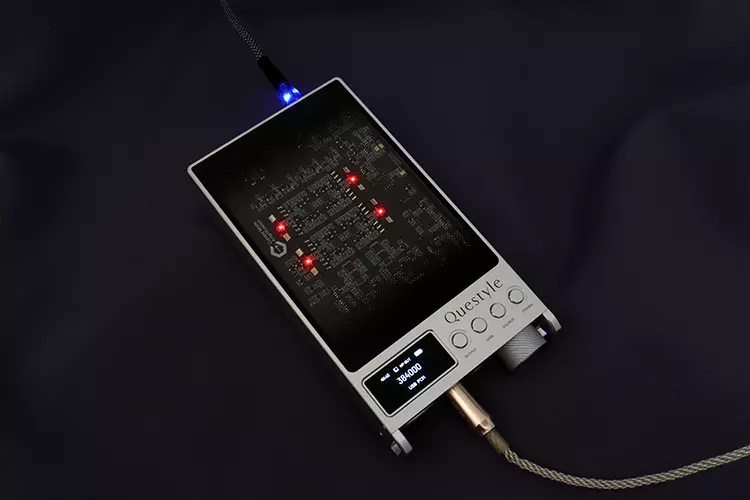
Features
One of the phrases that fits the Questyle SIGMA Pro well is versatility. It’s a portable device with a desktop component personality, rack mount handles, and a Pro studio-like sonic profile.
The Questyle SIGMA Pro combines a patented, proprietary headphone amplifier with a known good dual mono DAC section in a rather small chassis, and with a ton of connectivity options in the mix. That would be my general description of the SIGMA Pro.
The real icing on the cake is that the SIGMA Pro can be used as a separate amplifier, a dedicated DAC with preamp functionality, with its generous IO section, and it even has an analog recording feature.
A lot of goodies were stuffed in the sturdy chassis of the Questyle SIGMA Pro, including Bluetooth capability and LDAC wireless decoding, giving the end user yet another input option.
DAC
The Questyle SIGMA Pro uses a three-tier DAC architecture, or TTA decoding framework.
The DAC is a pair of pro-grade ESS ES9069 32-bit 2-channel chipsets in a dual-mono configuration. Very high dynamic range, low distortion, and ultra-low distortion are some of the highlights.
The SIGMA Pro can decode up to DSD512 and PCM 32-bit/768kHz with additional MQA unfolding if needed.
The front display gives you all the info you need to know, including the digital format being fed through the DAC, the input selection, and the gain level.
One thing I did not find was a set of digital filters, because there seem to be none available, even though it has become a common feature on most portable devices today.
Most of the time, digital filters are subtle, but I do feel as if the SIGMA Pro lacks some features since there are no menu options either.
Amplification
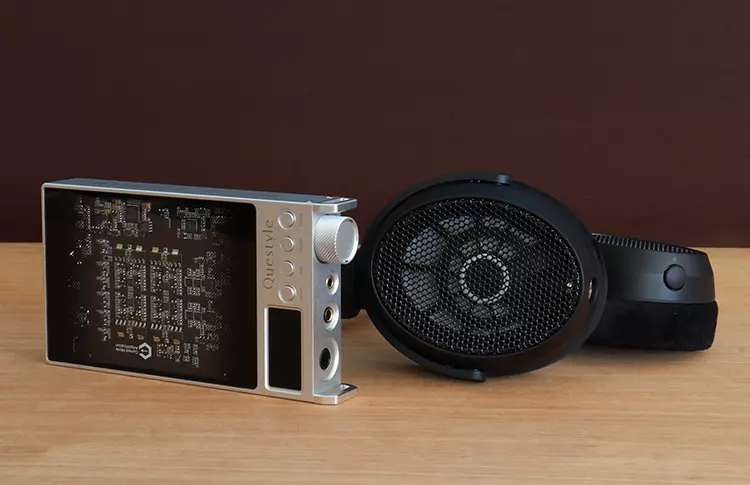
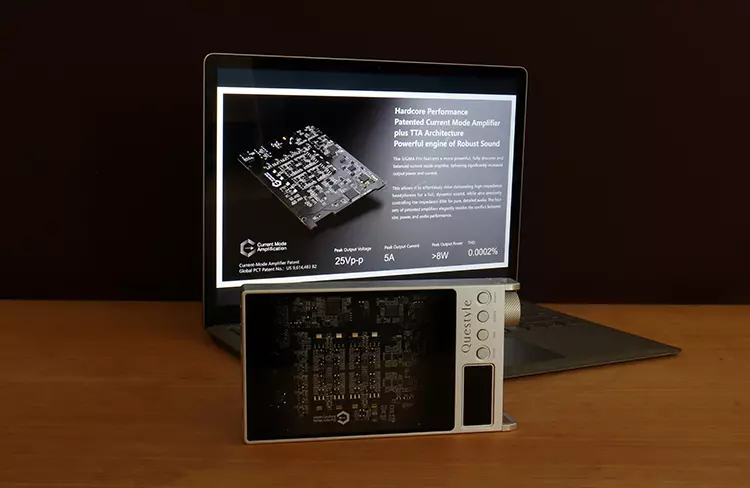
The Questyle SIGMA Pro amplifier section is also a TTA design that uses a patented Current-Mode amplifier implementation with a fully discrete balanced circuitry, with three output ports, and four separate internal amplifiers.
The bottom line on headphone amplification is that they should always be flexible enough to run power-hungry headphones and IEMs alike, and that’s a balancing act modern-day headphone amplifiers have to take into account.
Questyle combats this by first and foremost designing the amplifier section to be output impedance stable.
However, the power ratings are all over the place. There’s a 1200 mW spec, but there is also an 8-watt peak power output rating on their banner, which is outrageously high for a unit of this size. I’ll quote the 1200 mW rating all day, not the other.
Aside from that, there’s also a peak output current listing of 5 amps and a 25Vp-p voltage rating, which again are good numbers for a unit this size.
Design
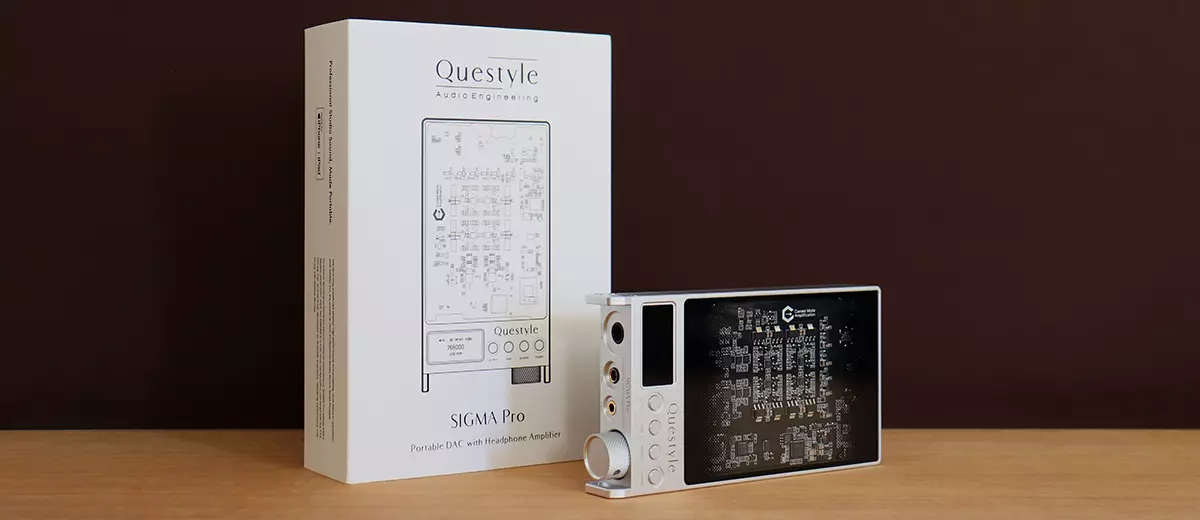
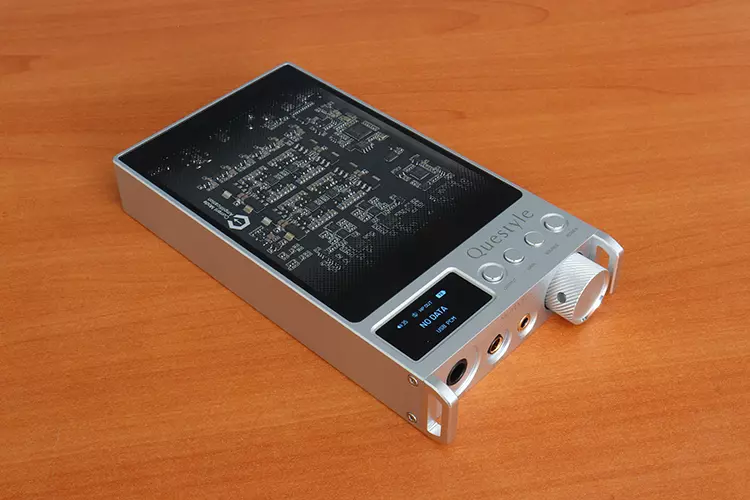
Most of the internal components of the SIGMA Pro are visible under a transparent glass, which is a typical design characteristic of Questyle’s component line.
Questyle’s upfront design lets you peek inside to see all the components neatly soldered onto a black PC board.
The outer chassis itself is made from aluminum and is very sturdy. The glass on the front and back is a nice touch, but make sure not to drop the unit, as it might crack the glass.
Weight and size are not too bad for portable use. The size and weight reminded me of an old-fashioned mechanical hard drive. It’s a hefty little device, and all the IO capability makes me feel as if the Questyle SIGMA pro was designed, or better intended, for home use.
My only worry is that when on the go, one drop or a hard blow will shatter the glass for sure. This one certainly needs a protective case. Questyle can capitalize on this by offering one as an upsell accessory. The SIGMA Pro merits one.
One of the factors that contributes to this is that the SIGMA Pro doesn’t have any surface that facilitates a firm grip on the unit. In fact, the glass makes it feel slippery in the hands. Again, I’d keep this baby at home and take her outside only on special occasions.
I/O
The front panel IO is the easiest to describe, so let’s start there.
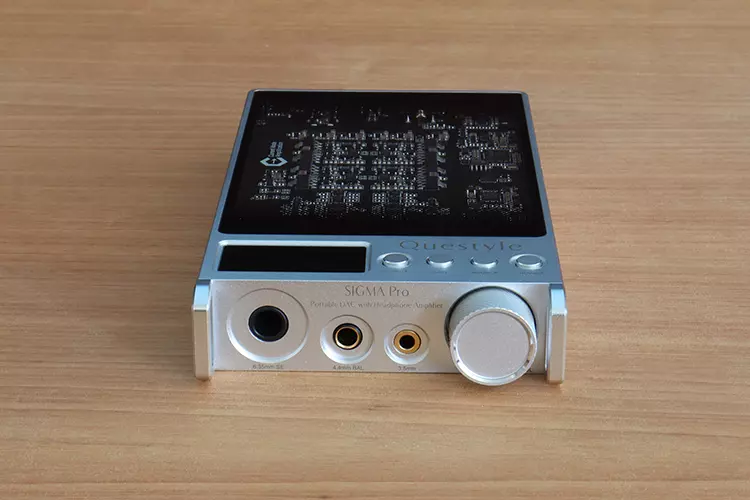
There are three headphone output ports. There’s a 3.5mm port, a 6.35mm port, both single-ended, alongside a 4.4mm balanced port, which sits in between the two other ports. The headphone outs can also function as selectable line outs.
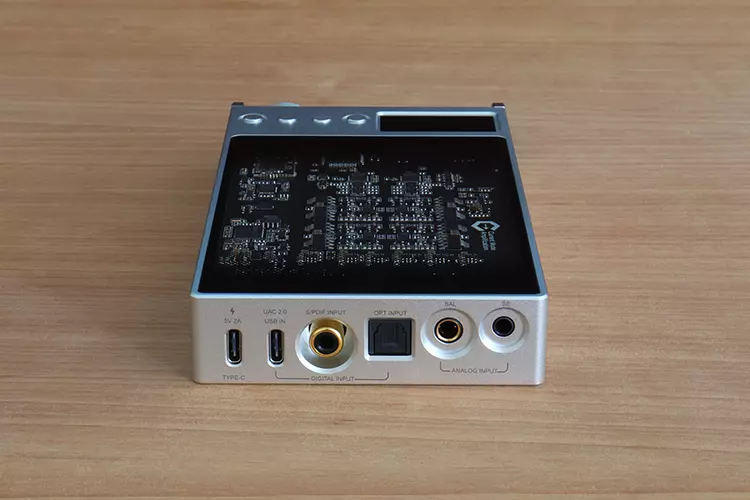
The rear IO is more complex because there are analog inputs and digital input variants as well.
On the analog front, there are two input ports: a 3.5mm and a 4.4mm. I’m assuming the 4.4mm port uses balanced topology. On the digital front, there’s a coaxial or SPDIF input with an optical input.
Alongside those ports are two USB-C connections. One is for data transfer to feed the DAC via an XMOS XU316, and the other is strictly used for charging the internal battery. I noticed there was no UAC 1.0 support, so make sure your source is UAC 2.0 compatible.
The SIGMA Pro has a lot of IO for a portable. I wonder what you could feed that optical port on the move? We haven’t even mentioned the Bluetooth yet, which is selectable via the input button, and yet another option to tap into the SIGMA Pro.
One feature of high significance to Apple product users is that the SIGMA Pro is Apple MFi Certified. That ensures compatibility with iPhones, meaning the USB ports consume small amounts of power, and that also seems true when tapped into Android devices.
Bluetooth
The Bluetooth section consists of a Qualcomm Snapdragon that can handle codecs at up to Sony-certified LDAC level.
It works under a 5.4 radio and also handles codecs like aptX Adaptive and aptX HD. The SIGMA Pro also has incorporated the LE Audio low-energy Bluetooth format.
I don’t expect much from Bluetooth reception since it’s prone to dropouts around corners, but the SIGMA Pro did well, and I could traverse a large open living space with no apparent issues.
The sound? It’s the typical Snapdragon Bluetooth sound that I would say 85% of what hard-wire setups can produce. There’s still a small amount of loss in the top frequencies, and a very small subdue in transients, that’s it.
Battery
The SIGMA Pro uses battery power wisely, or so it seems, since I noticed no battery drain when the unit is off, meaning there’s no standby battery drainage. Even when it’s on, there’s no battery drain, it seems, until you crank the volume.
The battery itself is a 4300mAh Lithium-ion battery that has a 3.7v output capacity and is charged with as little as 4.2v. Charging from zero takes around 2.5 hours using a high-capacity charger.
What I like most about the charging system is that it has a separate port from the data port, so you can charge the battery while simultaneously using the SIGMA Pro. That’s a good setup for a desktop, or even as a central hub, with a kick-ass headphone out.
Battery life is listed as capable of 12 hours of continuous use. I obtained approximately 9 hours with sensitive IEMs. That time diminished to under six hours when using a high-current demanding planar headphone, which is still not bad under today’s standards.
Controls
Most of the controls are placed on the side of the small display panel up front, and close to the volume knob.
The volume knob itself is knurled and has a visible orifice for a set screw. The knob seems to be made of metal, probably aluminum, and also has a push-to-mute feature.
The button array consists of four push buttons that control the power on/off, gain, output, and the source selection. There, you select your input method, either digital, analog, or Bluetooth.
The gain feature has three settings: low, high, and studio mode, which produces the highest volume setting. The output switch also doubles as the IEM or HP output mode selector, which gives you another two more levels of gain control.
I am somewhat disappointed due to the lack of onboard features like digital filters and screen time-out adjustments, but Questyle was going for a simple-to-operate device, and they did accomplish that in spades.
Packaging & Accessories
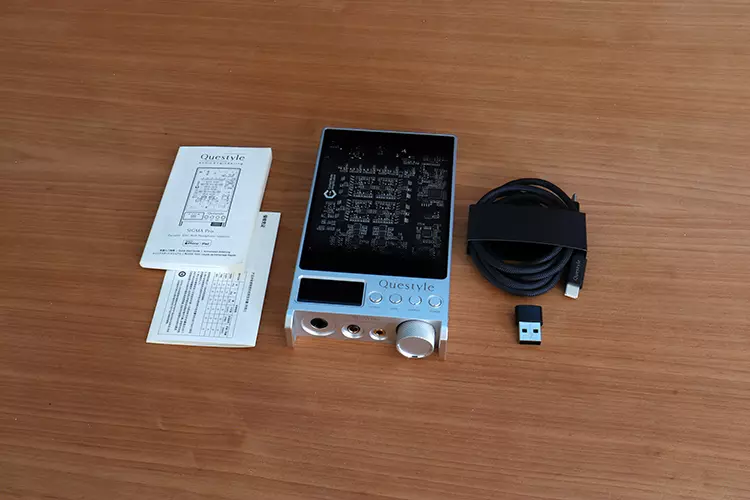
The packaging has a timeless white and black exterior with illustrations on the back and front. The inside is all black, and the main unit will be found sitting comfortably inside a cardboard mold.
You’ll also find a rather nice, cloth-wrapped, four-foot dual USB-C cable with a full-sized USB adapter. There’s no Apple Lightning connectivity for older units included, though compatibility is assured, just not out of the box.
The rest of the contents consists of paper. There’s a warranty registration form and a rather thick user’s manual, which is written in several languages.
Sound Impressions
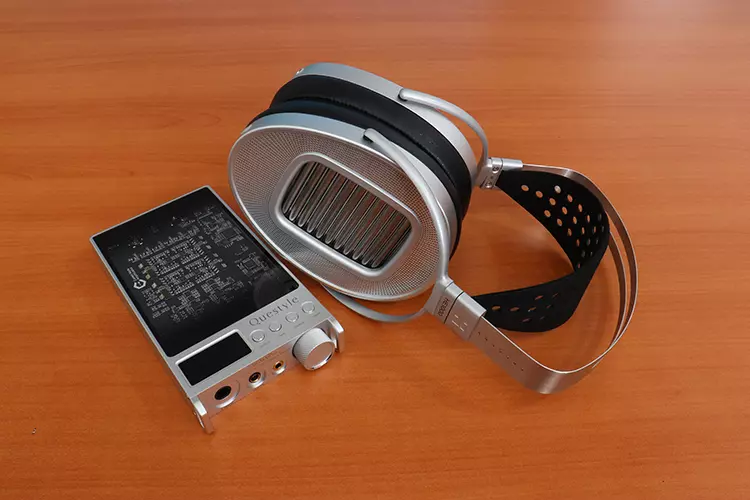
The most upscale headphone I used with the Questyle SIGMA Pro is the HIFIMAN HE1000 Unveiled. But I also used the Sennheiser HD 490 PRO Plus and the HEDD Audio HEDDPhone D1, as well as ORIVETI’s Grand Supremacy and FiiO’s FX17.
I fed the SIGMA Pro known FLAC files via a custom Windows 11 PC using Foobar. I also used an Android 16 mobile device with VLC mobile and the JetAudio + app.
Summary
What I got from the Questyle SIGMA Pro’s sonic signature is that it’s all about neutrality. That facilitates the SIGMA Pro to produce a performance that lets you see through a clear window what the source is trying to feed your ears.
Some might find it too neutral, but it is labeled as a Professional studio sound device, insinuating monitoring roots on the design table. If that’s what you’re looking for, here it is. It even says so on the box: professional studio sound, made portable.
The Questyle SIGMA Pro has a bright top end alongside a midrange that seems to be the center of attraction. The bass is as neutral as it gets and is not emphasized. I would even call it restrained or unadorned.
I also detect a niche here for producing nuances, microdetails, and its uncolorated character works in its favor to produce lots of detail that other combos miss, especially dongles and lower-tier DAC amp combos.
The Questyle SIGMA Pro produces a crystalline version of what is interpreted via the input. But what I like most about the SIGMA Pro’s sonic signature is the almost analog sonic character it produces from digital formats, which keeps this model from sounding sterile with a hint of needed warmth.
Staging & Dynamics
The Questyle SIGMA Pro produces what I call a focused sonic signature. Every element is produced with lots of dynamics, but at the same time, all elements sound very focused, making it easy to distinguish what’s within a recorded track.
The soundstage size, height, width, and depth are mostly determined by the headgear being used. But the SIGMA Pro tends to favor depth and height over other aspects.
Width is adequately represented, but there’s a tendency to come across as the narrowest part of the staging capabilities.
That, at times, can alter left-to-right placement, but the SIGMA Pro remained controlled by not condensing elements, but rather by bringing them into focus in a more forward and focused manner.
Click on page 2 below for my recommended pairings and selected comparisons.
creditSource link