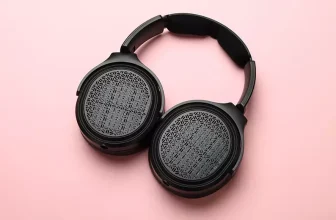


This is the review of the ZMF Headphones Tessidera Open-back headphone. It is selling for $2,499.99 USD.
Disclaimer: The ZMF Tessidera was sent to me by ZMF Headphones directly in exchange for our honest opinion.
ZMF
ZMF Headphones stands for Zach Mehrbach Films and they are a brand that’s no stranger to the world of high-end audio, at least within the realm of the headphone audiophile. The company is helmed by the dynamic husband-and-wife duo, Zach and Bevin Mehrbach.
Together, they are purveyors of a host of fantastic-sounding and awesome-looking products. Simply drop by their website, and take a gander at their growing stable of headphones, and you won’t, or can’t, tear your eyes away from them.
When working on our designs we take our slogan very seriously; “Traditional Craft, Modern Acoustics.” We strive to make every headphone show inspiration from timeless artistry, film, culture and history. When melding this with current headphone technology and Zach Mehrbach’s proprietary damping systems, each headphone is made to become an instant classic.
ZMF are wood masters. If you’re an audiophile, your weapons-of-choice are distinctly headphones, and you’re a connoisseur of wood (is there such a thing?), then ZMF is a brand for you.
If you want to learn more about ZMF, you can do so on their website here. I’ve met Zach and his team on multiple occasions at different shows, and they’re always very kind and a pleasure to talk to.
In this newest article we will be covering the Tessidera open-back headphone. Let’s go!
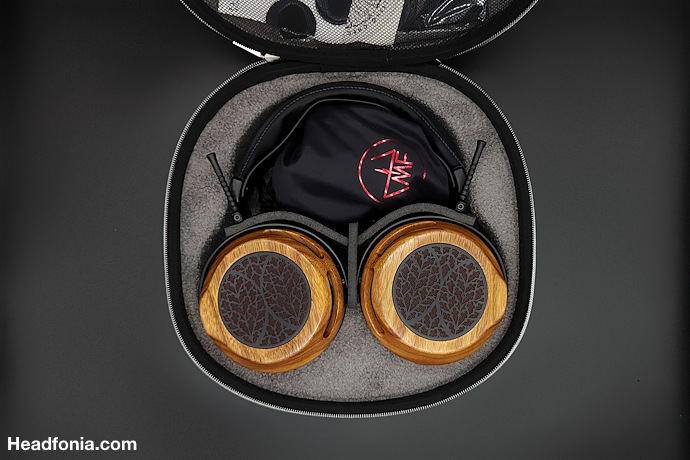
Tessidera
The ZMF Headphones Tessidera is the company’s newest planar magnetic headphone that represents the most technologically integrated design in their history.
Named to complement ZMF’s flagship Caldera, the Tessidera draws its identity from two sources: tessera, the interlocking mosaic tiles of classical craftsmanship, and tessitura, the musical term describing the range where an instrument resonates most naturally. Like its volcanic sibling, the Tessidera embodies the marriage of artisan woodworking and acoustic innovation that defines ZMF.
The Tessidera also represents the culmination of ZMF’s acoustic research, bringing together five technologies that work not as independent features, but as an integrated system.
CAMS (Caldera Asymmetrical Magnet Structure): The foundation of ZMF’s planar technology, CAMS uses dual-sided trapezoidal N52 neodymium magnets to create even magnetic tension across the diaphragm while pushing air toward the ear with controlled diffusion.
ADS (Atrium Damping System): ZMF’s patent-pending rear damping architecture controls pressure and airflow behind the driver, minimizing back-wave cancellation while enhancing perceived depth through strategic diffusion and driver placement.
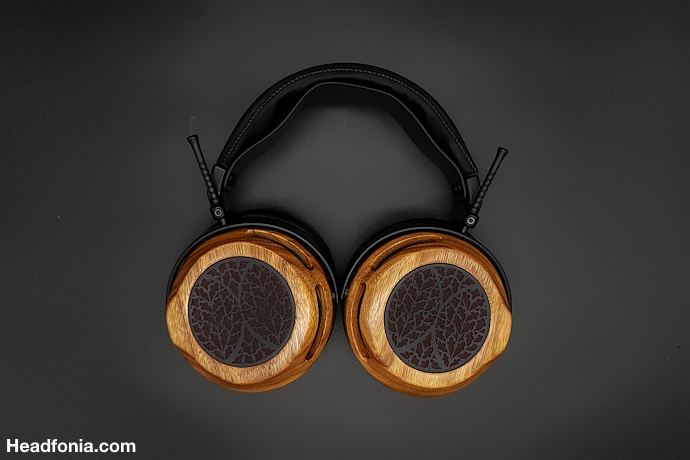
ZAM (ZMF Acoustic Matrix): The new lattice diffusion system that eliminates standing waves and smooths the treble region while preserving dynamics.
SRS (Soundboard Resonator System): The new wood resonator that adds punch, controls the midrange, and brings instrumental resonance to the planar platform.
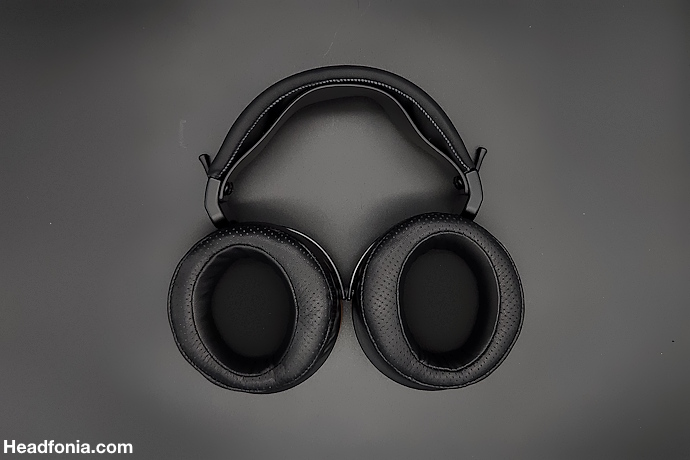
ZMF Caldera Pad System: The Caldera pads feature an inside-out fluted design that channels airflow from the driver membrane directly to the ear. Combined with semi-vented airflow and an asymmetrical angled geometry, the pad system introduces dimensionality and spatial presentation that complements the planar driver’s capabilities.
Together, these technologies address the challenges that many planar magnetic headphones face—delivering the explosive dynamics, tactile slam, and tonal richness traditionally associated with dynamic drivers, while retaining the speed, resolution, and planar precision that enthusiasts demand, along with natural decay that give ZMF’s the musical timbre that has become a hallmark of ZMF.
The Tessidera also features a newly developed planar driver with a 1-micron diaphragm thickness—thinner than the Caldera’s 2-micron design. At 35 ohms impedance with thicker traces and ZMF’s TPE construction with silver plating, the driver delivers an easier, smoother presentation that opens the Tessidera to a wider range of amplification while maintaining the technical excellence of ZMF’s planar platform. We’ll find out more about this later in this article.
If you want to find out more about the Tessidera you can do so here. You can buy it directly from ZMF or via one of their dealers. If it’s a strange Tessidera video you want, check here.
Pads & Cable
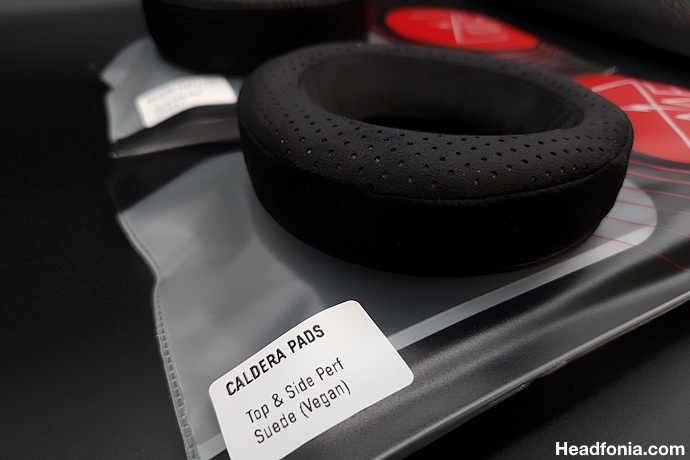
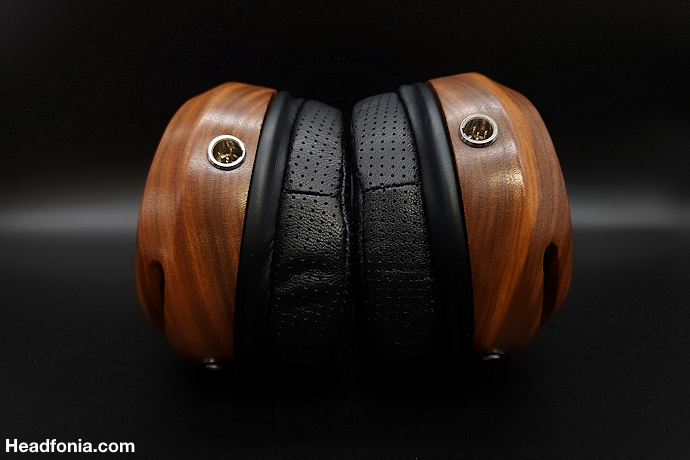
The latest ZMF Tessidera uses the Caldera pads and you have the choice between Caldera Lambskin or suede (top and side perf), though we also received the Thick Caldera lambskin pads. (top and side perf). When ordering you can choose the installed pads and the secondary pads. Extra pads can be ordered for a $80 USD surcharge.
Check out our previous reviews to find out more about all these different pads. If you’re interested in seeing ZMF’s pads measurements, you can go here.
From ZMF:
The Tessidera ships tuned to our Stock Caldera Lambskin Top/Side Perf pads. Of everything we tested, this pairing delivered the best overall balance: fast, lively transients without sacrificing natural decay; a spacious stage with that rich, organic midrange tonality that doesn’t sound like a planar at all. That said, we found some great alternatives worth exploring, which are offered as the included secondary pad options. All descriptions may vary based on your HRTF.
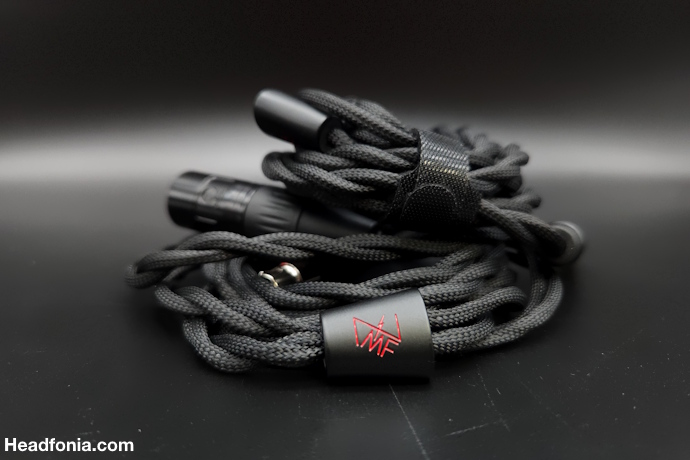
Cable wise you can choose one included stock cable, and you have the option between a 2.5mm, 3.5mm, 4.4m, XLR and 6.35mm termination. An extra stock cable goes for $60 USD, while an Upgrade cable can even add $1,200 USD to the purchase price (Grand Palladium Silver).
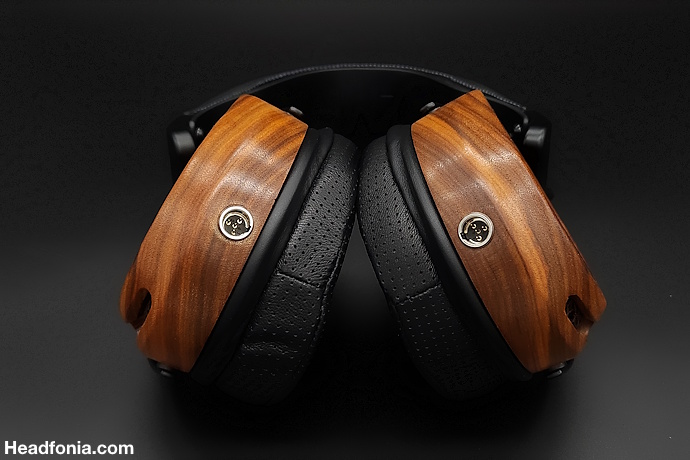
The termination on the headphone side is mini-xlr, so it’s very easy to use fancy aftermarket cables, if you’d want to.
Design, Build Quality
When ZMF releases a new headphone, it’s always exciting to see what design and wood they have come up with.
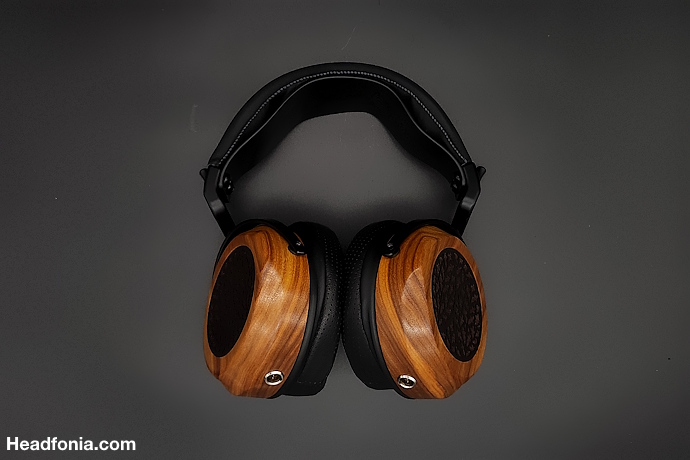
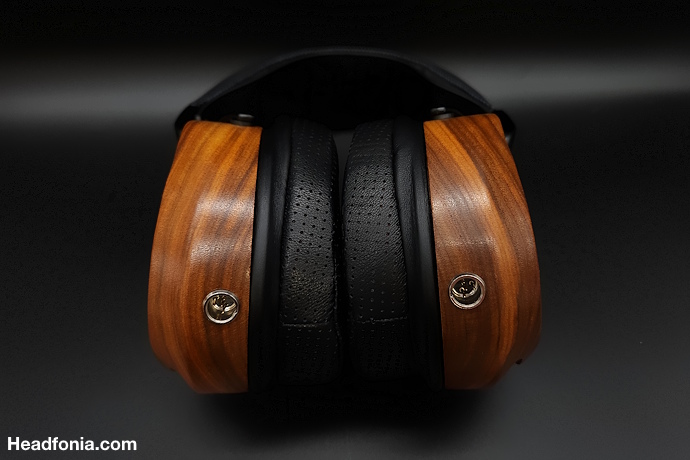
The Tessidera debuts in rich and subtly colorful Canary wood with a black rod and grille structure, a brown premium mesh cloth, and introducing the ZMF Acoustic Matrix in coordinating Chocolate Brown.
You have frame options, and the choice is between aluminum black leather or suede, or the MG12 band with black leather or suede. The latter are an additional $300 USD.
True to ZMF tradition, each Tessidera is handcrafted in the United States, featuring the company’s signature hardwood cups available in a variety of premium wood species. The combination of artisan woodworking and cutting-edge acoustic technology creates a headphone that is as beautiful to behold as it is to hear.
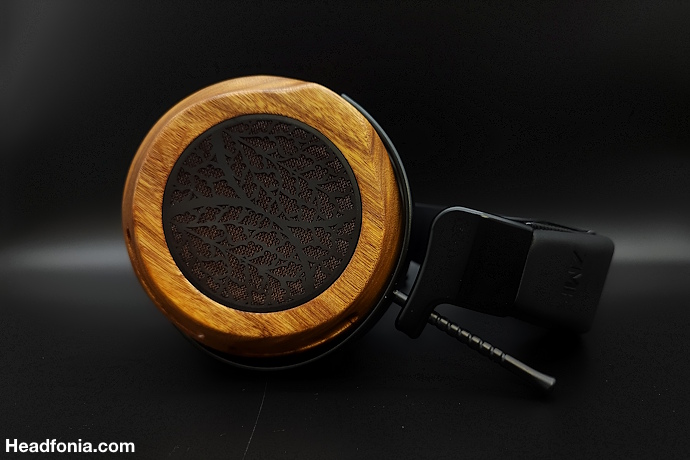
To me, the Tessidera looks gorgeous. I love the headband with the T logo, the soft perforated pads, brown mesh and especially the grill (cutout). Canary wood perhaps looks a bit simpler on this one, but the quality is high.
Build-wise we already know that ZMF only delivers high-end products with a sublime finish, and that’s no different this time round. Top marks for design and build.
Sound
This is the section where we find out how the brand describes the sound signature of the unit in question. For the Tessidera, we find the following:
Where the Caldera is energetic and bombastic, the Tessidera offers a different expression of the ZMF planar vision: liquid, lush, and euphonic without ever becoming relaxed or boring. The five-technology system delivers a smooth, extended presentation with punchy excitement—a macro-dynamic headphone that trades raw energy for refined musicality.
The ZAM lattice smooths the treble region while the SRS resonator adds weight and punch to transients, creating a cohesive midrange-to-treble presentation that rewards long listening sessions. This is not a laid-back headphone—it’s a lush, engaging experience that maintains the impact and dynamics ZMF is known for, wrapped in a smoother, more refined delivery.
Let’s dive in.
Sound – General
For the Tessidera it’s easy to say that the typical ZMF house sound is present here, and that’s always a good thing.
I would say it’s a fairly balanced headphone, at least up to the 300 range. There we start to see a dip/valley up to the 600 mark. The next dip is from 1k to 1.5k, followed by an increase all the way up to almost 3k. From there on we have some smaller peaks and drops, before dropping after the 7k mark.
I wouldn’t call the Tessidera v-shaped as overall the mids are not recessed, there’s only the drop right before the treble region starts. This is very audible in the vocal presentation and upper mid notes. The Tessidera shows a fluid and impressive bass to mid transition
Pure from a tuning perspective, I would not call ZMF’s latest a neutral headphone, but it doesn’t pretend to be one either. Instead expect a more smooth and lush presentation, but never overly done.
The Tessidera is a punchy headphone, and it has good impact in the bass and mid bass. Together with the vocals, the (upper) mids are the stars of the show. Soft, slightly warm and lush are fitting descriptions of the headphone, and especially the mid region.
The top end is lively enough but never becomes harsh, it’s always musical and still soft on the ears. For a planar magnetic design, the Tessidera has a very dynamic presentation. It’s not laid back or slow at all, but it’s very engaging.
The Tessidera has a good technical level, think precision, PraT, extension, separation and decay, but ZMF has already impressed us more with the Caldera Open. The soundstage here is good in both width and depth, but it’s not the most extended in either way. The depth and layering improve based on the amplification in your setup.
To me, the Tessidera is fine blend of technical power and musical excellence, where the enjoyment is more important than refinement and ultimate detail. If you like your mids and vocals most and in a soft, lush way, Tessidera will not disappoint. Especially if you also like a bit of upper mid and vocals forwardness.
We’ll continue our part on sound in the pad, synergy and comparison sections.
Sound – Pads
If you’ve ready any of our or other ZMF reviews, you know they often offer multiple tuning options for each headphone. In the case of the Tessidera, the only way of tuning is by changing the pads.
ZMF usually offers a description of what to expect from the different pads, and they often have measurements as well. You can find the dedicated ZMF pad page over here.
As said before, the stock pads are Lamb Caldera ones with the top and side perforation. Why these specific pads? According to ZMF, this pairing delivered the best overall balance: fast, lively transients without sacrificing natural decay; a spacious stage with that rich, organic midrange tonality that doesn’t sound like a planar at all.
Thick Caldera TSP
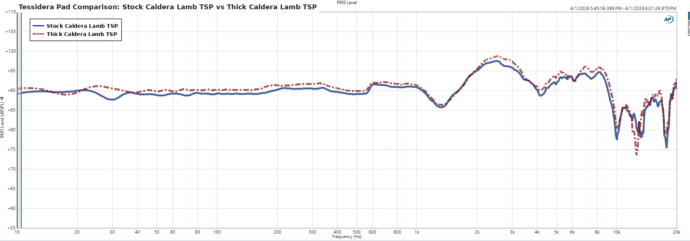
The thick TSP Caldera pads increases driver-to-ear distance, which widens the perceived soundstage and shifts upper-frequency energy — you’ll notice a slight boost in presence and a slightly more U shaped response that will be exciting to many, while bass weight and sub-bass extension stay very close the added air volume in the deeper chamber provides marginally longer acoustic decay and a slightly more spacious presentation.
Suede TSP
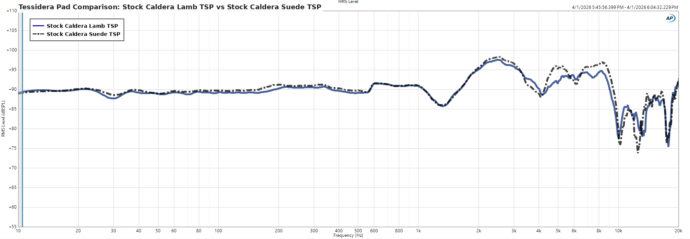
The suede surface acts as a natural acoustic absorber, gently damping upper-midrange energy and softening treble transients compared to the more reflective lambskin — you’ll hear a slightly smoother, more relaxed presentation with a touch less attack which we find nice for long sessions. Suede’s increased damping yields a subtly warmer, more laid-back staging character, albeit with a slightly more linear sound.
As you can see from the curves, the differences on paper aren’t huge. That said, there really is an audible difference and I certainly recommend trying out the different pads to see what signature suits you most.
For myself, I find all three sets to be comfortable so don’t change pads just for that. The suede ones feel a bit softer, where the thick ones – depending on the size of your head – can feel a bit squishier. I can agree with the consensus that the suede pads increase the overall airiness, delivering a smoother and softer tonality with a more relaxed presentation. The top end increase on paper isn’t that audible to me. I quite like this tonality, though I also appreciate the snappier, more focused tonality of the leather pads.
With the thick SPF Caldera pads you get more body, weight and power, especially in the bass regions. This does sound more like a V-shaped presentation even if this on paper doesn’t seem to be the case. For me these are the pads I like least even if the top end energy is nice. If this signature is your thing, you’ll be pleased to hear the impact of the thick pads.
The choice for me here is simple: the stock Caldera TSP ones give the best overall performance and balance.
The ZMF Headphones Tessidera review continues on page two with more on Sound. Click here or use the jumps below.
creditSource link