
Meldrick reviews the Topping DX1 II, an affordable desktop integrated ES9039Q2M DAC and headphone amplifier with up to 1W of output power. It is currently priced at $119.00.
Disclaimer: This sample unit was sent to me in exchange for my honest opinion. Headfonics is an independent website with no affiliate links or status. I thank the team at Topping for supporting us.
Click here to read more about Topping products previously reviewed on Headfonics.
This article follows our current scoring guidelines, which you can read in more detail here.
Topping’s original DX1 set a benchmark at the $99 price point that most competing brands spent years trying to match.
Today, the brand refreshes that formula with the DX1 II, a fully redesigned all-in-one USB-powered DAC and headphone amplifier launched in early 2026.
Priced at $119, the DX1 II arrives with a substantial spec upgrade over its predecessor: an ESS ES9039Q2M DAC chip, a fully balanced architecture, a 4.4mm balanced headphone output, a 4-pole headset input with microphone support, independent optical input and output, and a 10-band parametric EQ.
On paper, the DX1 II looks less like an incremental update and more like a ground-up rethink of what a sub-$150 desktop DAC/AMP can deliver.
To see whether the DX1 II delivers on those ambitions, and how it competes against the FiiO K11, iFi audio ZEN DAC V1, and Shanling EH1, read my full review below.
Features
The DX1 II is built around ESS’s ES9039Q2M DAC chip, the same silicon found in Topping’s higher-end DX5 II, and operates within a fully balanced architecture that carries the signal path through to both the headphone and line outputs.
This is a meaningful departure from the original DX1’s AK4493S chip and single-ended topology, and represents a notable jump in technical ambition for the price.
Output power is rated at 1000mW per channel into 32Ω, a substantial increase over the original DX1’s 280mW, achieved without requiring an external power brick. The DX1 II is powered entirely via USB-C, with computers and tablets able to supply sufficient power for standard operation.
The DX1 II includes a 10-band parametric EQ, configured through Topping’s Tune desktop application and mirroring the implementation found on the higher-end DX5 II.
Each of the ten bands allows independent adjustment of frequency center, gain, and Q-factor, giving users meaningful control over the unit’s output signature beyond simple tone shaping.
EQ profiles can be saved directly to the unit’s hardware memory, meaning a dialed-in correction curve persists across listening sessions without requiring the computer to remain connected during playback.
For a sub-$150 device, this is a genuinely useful and practically implemented feature rather than a spec-sheet checkbox.
Design
The DX1 II maintains the compact, desktop-friendly footprint that made its predecessor a popular pick for cramped workstation setups.
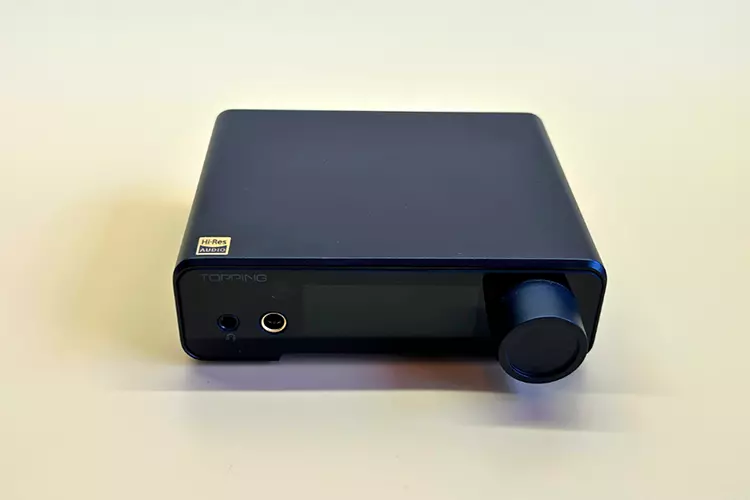
The chassis is machined aluminum and follows Topping’s increasingly confident industrial design sensibility with clean lines, a brushed finish, and minimal surface decoration that keeps the unit from looking out of place on most desks.
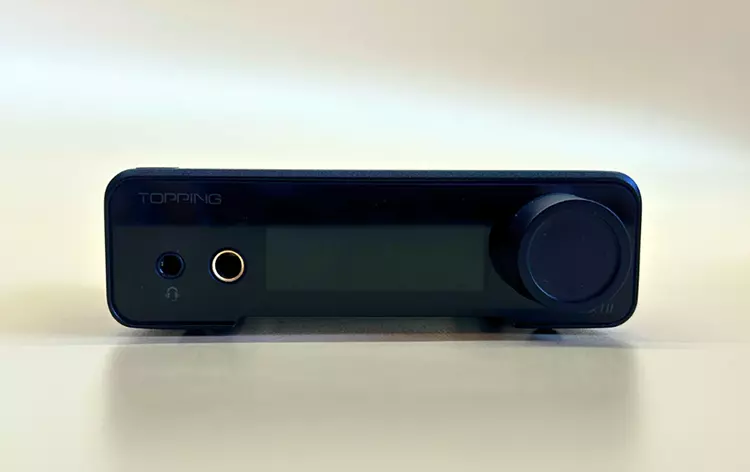
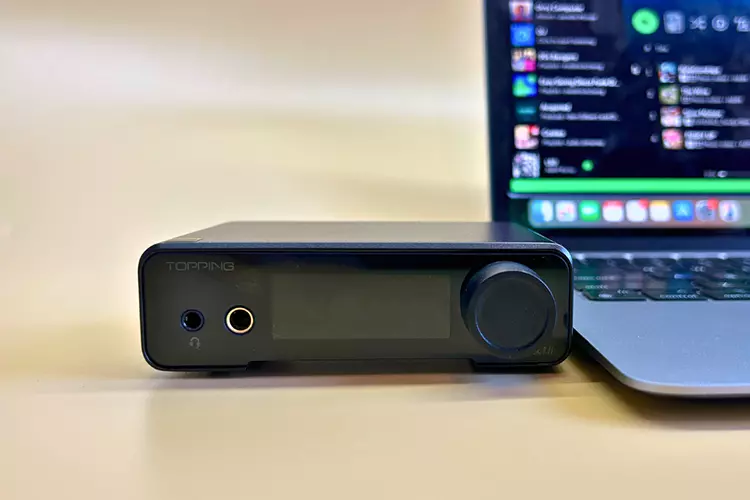
The front panel is simple and functional: a single volume knob dominates the face, flanked by the 3.5mm TRRS headset jack and the 4.4mm balanced headphone output.
The inclusion of the 4-pole TRRS input here is a notable departure from the audiophile-only positioning of the original DX1, and gives the unit credibility as a work-from-home and gaming peripheral as much as a dedicated listening source.
Unlike some competitors that tack on gaming-adjacent features with visible aesthetic compromises, the DX1 II keeps its exterior restrained.
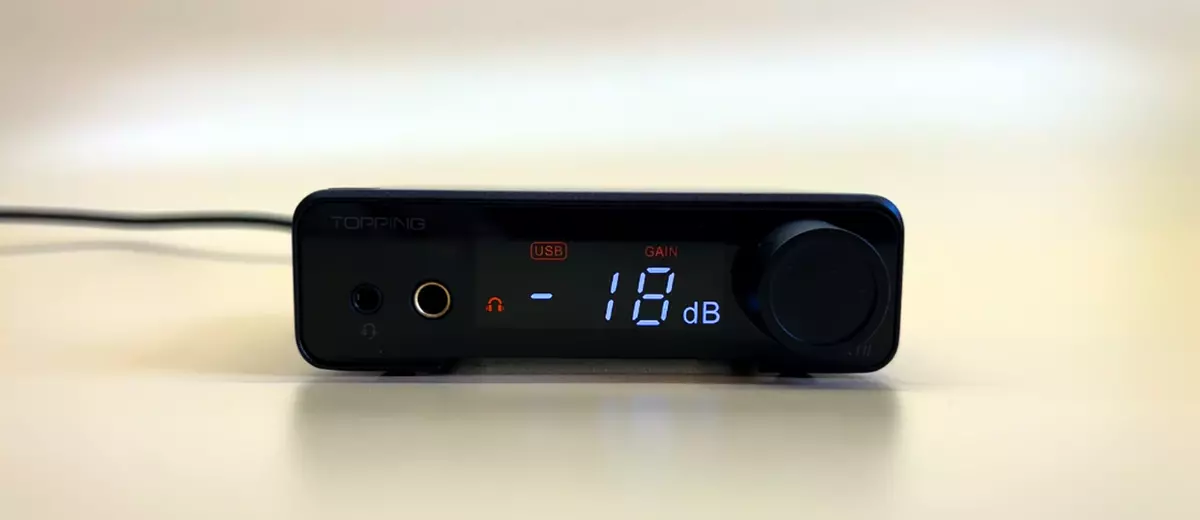
The DX1 II includes a small display on the front panel that reads out current volume in dB, the active input source: USB or optical, and the current output mode.
It is not a full-featured interface by any means, but it covers the practical at-a-glance information that matters most during daily use, and it addresses one of the more common criticisms of similarly priced competitors that ship with no display at all.
The unit is available in black, white, and silver finishes, with the review unit received being the black variant. Build quality feels dense for the price, with good panel fit and a volume knob that offers smooth, confident rotation.
I/O
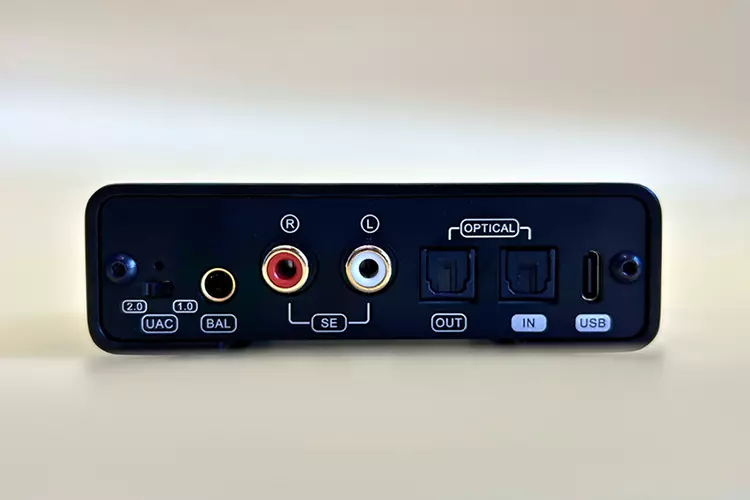
The DX1 II features direct USB-C input alongside an independent optical S/PDIF input and output, providing digital connectivity options well beyond what is typically offered at this price point.
The optical output in particular is a genuinely useful addition for users who want to route digital audio downstream to a standalone DAC or AV receiver, a feature I found practical when connecting to older desktop equipment.
The USB-C input supports PCM audio up to 32-bit/384kHz just like the original DX1. However, PCM support may be limited to 32-bit/192kHz when PEQ is enabled. In practice, this was a non-issue for the overwhelming majority of available streaming and local audio content.
On the output side, the front panel provides both a 3.5mm TRRS headset connection and a 4.4mm balanced headphone jack. The TRRS connection doubles as a microphone input, enabling single-cable communication setups for gaming and video calls.
The rear panel adds RCA single-ended line outputs as well as a 4.4mm balanced line output, the latter being genuinely unusual at this price and useful for users connecting to balanced amplifiers or active monitors.
The DX1 II can be powered by computers and tablets via USB-C, though not all smartphones may provide sufficient current for full operation.
Unlike competitors such as the FiiO K11 and Shanling EH1, which rely on external power bricks or dedicated DC inputs for full amplifier performance, the DX1 II’s bus-powered approach keeps cable clutter to a minimum and the overall setup genuinely simple.
Controls
The DX1 II’s front panel is anchored by a single rotary encoder that handles volume adjustment, accompanied by a small display that reads out current volume in dB, the active input source, and the current output mode.
Single-pressing the knob cycles through inputs, USB to optical, while double-pressing cycles through the three output configurations: headphone output only, line output only, or both simultaneously.
It is a clean and intuitive system that keeps the front face uncluttered while still covering the most common operational adjustments.
All PEQ adjustments are handled through the Topping Tune desktop application on PC or Mac, with up to three saved profiles recallable directly on the device.
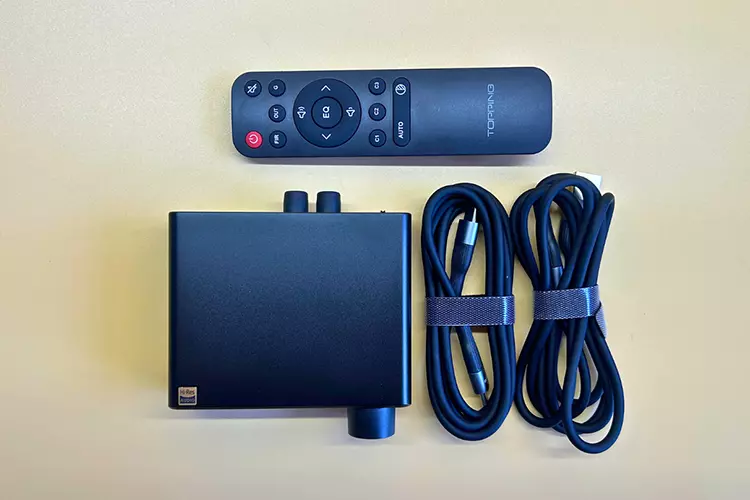
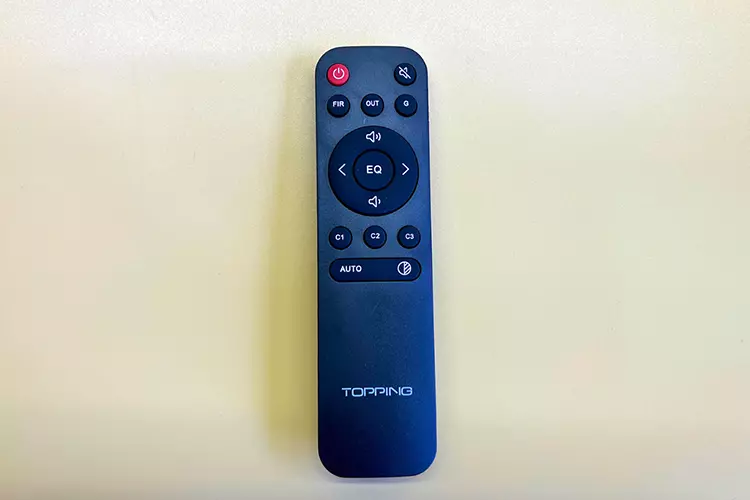
The included remote expands operational flexibility considerably, adding dedicated controls for standby, mute, digital filter cycling, output cycling, volume adjustment, input selection via the side buttons, and an EQ button in the center that cycles through the three saved PEQ profiles or disables EQ altogether.
While not clearly stated, gain adjustment can be done on-device by pressing in the knob for 1.5 seconds, and rotating clockwise for high gain, and counterclockwise for low gain.
While it may be a nitpick, I have become accustomed to clearer gain controls on other amplifiers, may it be in the form of the onboard menu or a hardware toggle switch.
Plug-and-play compatibility with Windows, macOS, Linux, and most mobile platforms means no driver is required for standard UAC 2.0 use, though driver installation unlocks full functionality on Windows.
The rear UAC toggle switches the unit to UAC 1.0 mode for console compatibility with the Nintendo Switch and PlayStation 5, a practical addition for users who share their audio chain between listening and gaming setups.
Packaging & Accessories
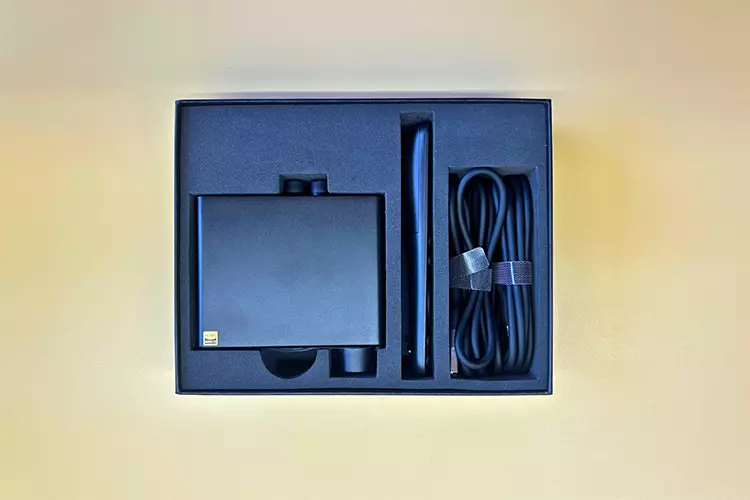
The DX1 II arrives in compact packaging consistent with Topping’s recent product presentation, a clean black box with “Topping” plastered on the front, and the unit nested securely within shaped foam.
Included accessories are minimal but functional: 1x USB-A to USB-C cable, 1x USB-C to USB-C cable for source connection, a remote control, and a product information card
Notably, no 3.5mm TRRS splitter is included, which may be a minor inconvenience for users with high-end gaming headsets or separate headphones and microphones.
The USB-C power and data integration keeps the accessory footprint minimal, which is in keeping with the unit’s bus-powered positioning.
Sound Impressions
The following sound impressions were made with the Sennheiser HD 600, HarmonicDyne BAROQUE, Audio-Technica R70X, Modhouse Argon Mk3, MOONDROP Blessing 3, and Yanyin Canon II as my main headphone and IEM pairings.
Unless otherwise specified, all tests and comparisons on the DX1 II were completed with the PEQ disabled at its neutral position and the unit connected via USB-C to an M1 MacBook Air.
Bass
The DX1 II’s bass presentation is tight and well-controlled, prioritizing definition and separation over sheer weight and quantity.
Sub-bass extension is solid and reaches deep without artificial enhancement or roll-off, and there is good texture in the lowest registers. Bass kicks and 808s are conveyed with enough tactility to be felt without being overly artificial or boomy
The overall bass quantity, however, leans on the leaner side of neutral, and listeners coming from warmer sources may find the initial impression somewhat restrained. Mid-bass is clean and quick, with a fast transient response that keeps kick drum hits punchy and well-defined without bleeding into the lower midrange.
Double bass and bass guitar carry good textural detail and string resonance, though the presentation lacks the organic warmth and note density that R2R-based alternatives naturally provide.
The DX1 II responds cleanly to bass shelf boosts through its PEQ without audible distortion or bloom, making it a practical corrective tool for listeners who prefer a fuller low-end. For bass heads, some PEQ intervention will likely be welcome.
Mids
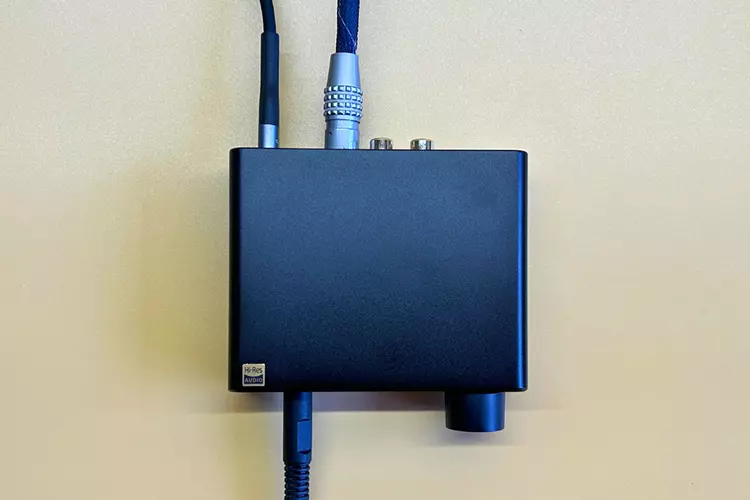
The midrange is the DX1 II’s strongest performance area and the region where the ES9039Q2M chip makes its most compelling argument for the price.
Vocal reproduction is detailed and immediate, male vocals present with solid body and chest resonance, and female vocals are rendered cleanly and with good projection without any edge or sibilance creeping in at moderate listening volumes.
There is a slight upper midrange forwardness, adding a sense of presence and intimacy to lead vocals and forward-mixed instruments that gives the DX1 II an engaging, attentive quality.
Acoustic instruments render with natural harmonic structure and good transient definition, acoustic guitar fingerpicking has clarity and note separation, and piano has convincing key weight and decay.
String ensemble and orchestral passages carry adequate air and separation without sounding compressed or congested.
Where the DX1 II concedes some ground relative to warmer or more colored sources is in sheer midrange density.
The presentation can occasionally sound lean or slightly thin on recordings that benefit from a fuller-bodied source, and this leanness becomes more apparent with lower-quality recordings, where the DX1 II’s transparency exposes production flaws rather than smoothing over them.
Treble
Treble reproduction is detailed, extended, and one of the DX1 II’s most defining sonic characteristics. Cymbal shimmer and hi-hat articulation are rendered with good body and definition, avoiding the thin, metallic quality that cheaper delta-sigma implementations sometimes exhibit.
The DX1 II retrieves high-frequency microdetail like the subtle overtone structure of bowed strings, the transient edge of a struck triangle, and the air in a well-recorded acoustic space with a confidence that is genuinely impressive for a sub-$120 device.
The caveat is that with brighter, more forward headphones, the DX1 II’s upper frequency energy can occasionally tip toward sharpness on particularly aggressive or compressed recordings.
10-band PEQ handles this effectively with a modest upper treble shelf reduction, and the unit takes that adjustment cleanly without introducing artifacts. Listeners who pair the DX1 II thoughtfully with appropriate headphones will find the treble performance a genuine strength.
Staging & Dynamics
Soundstage presentation on the DX1 II is precise and well-organized, delivering a convincing sense of three-dimensional space without artificially inflating width or depth beyond what the recording contains. Lateral separation is clean with a convincing sense of front-to-back depth layering.
Imaging accuracy is a particular standout for the price. Instrument placement is tight and positionally stable across the soundstage, with minimal blurring or smearing even in dense, layered mixes.
The DX1 II consistently outperforms the typical expectation for its price bracket in localization precision, which is most apparent on complex classical and live jazz recordings, where placement accuracy significantly contributes to the sense of realism.
Dynamic range is competent; the DX1 II tracks loud-to-soft contrasts in well-mastered recordings cleanly and without artificial compression, resolving the quiet passages in a classical piece or the sudden drop in a live recording with appropriate delicacy.
Click on page 2 below for my recommended pairings and selected comparisons.
creditSource link