come with many interesting features and support a long list of applications. However, there may be times when you wish you could turn any of your ideas into a particular feature of your
or a dedicated app. This might actually become a reality in the near future, as Samsung is reportedly exploring the idea of vibe coding.
Pre-order the Galaxy S26 and save up to $500
$399 99
$899 99
$500 off (56%)
The Galaxy S26 brings an improved design and more powerful processor and more optimized software. The best part? You can pre-order the device for up to $500 off with eligible trade-ins. Users also receive a $30 Samsung credit, available for a limited time.
Pre-order at Samsung
Add features and apps you wish your Galaxy phone had
First, let’s address the elephant in the room – what exactly is vibe coding? In layman’s terms, vibe coding refers to using an AI model to write software code for you. The best part is that you don’t even need programming knowledge to take advantage of this concept. All you have to do is give the AI model a prompt in natural language, and it will generate the code for a working app.
It isn’t something very new or futuristic. Instead, using AI to help with coding or to code entire programs has always been one of the main use cases of LLM models.
That being said, Won-Joon Choi, head of Samsung’s mobile experience division, was recently asked whether vibe coding will ever come to Galaxy smartphones. Replying to the question, he reportedly said that it’s “something we are looking into.”
Talking about how vibe coding could help smartphone users, he mentioned that “it opens up the possibility of customizing your smartphone experience in new ways, not just your apps but your UX.” He further noted that end users are currently limited to apps and features that are made available to them by developers. But with the addition of vibe coding, users would gain the power to customize their favorite apps or features according to their needs.
Android’s main highlight has always been how open it is compared to other operating systems like iOS. You have the freedom to sideload any application on your device, and considering this, baking vibe coding directly into One UI seems very doable.
It could have some real-life use cases
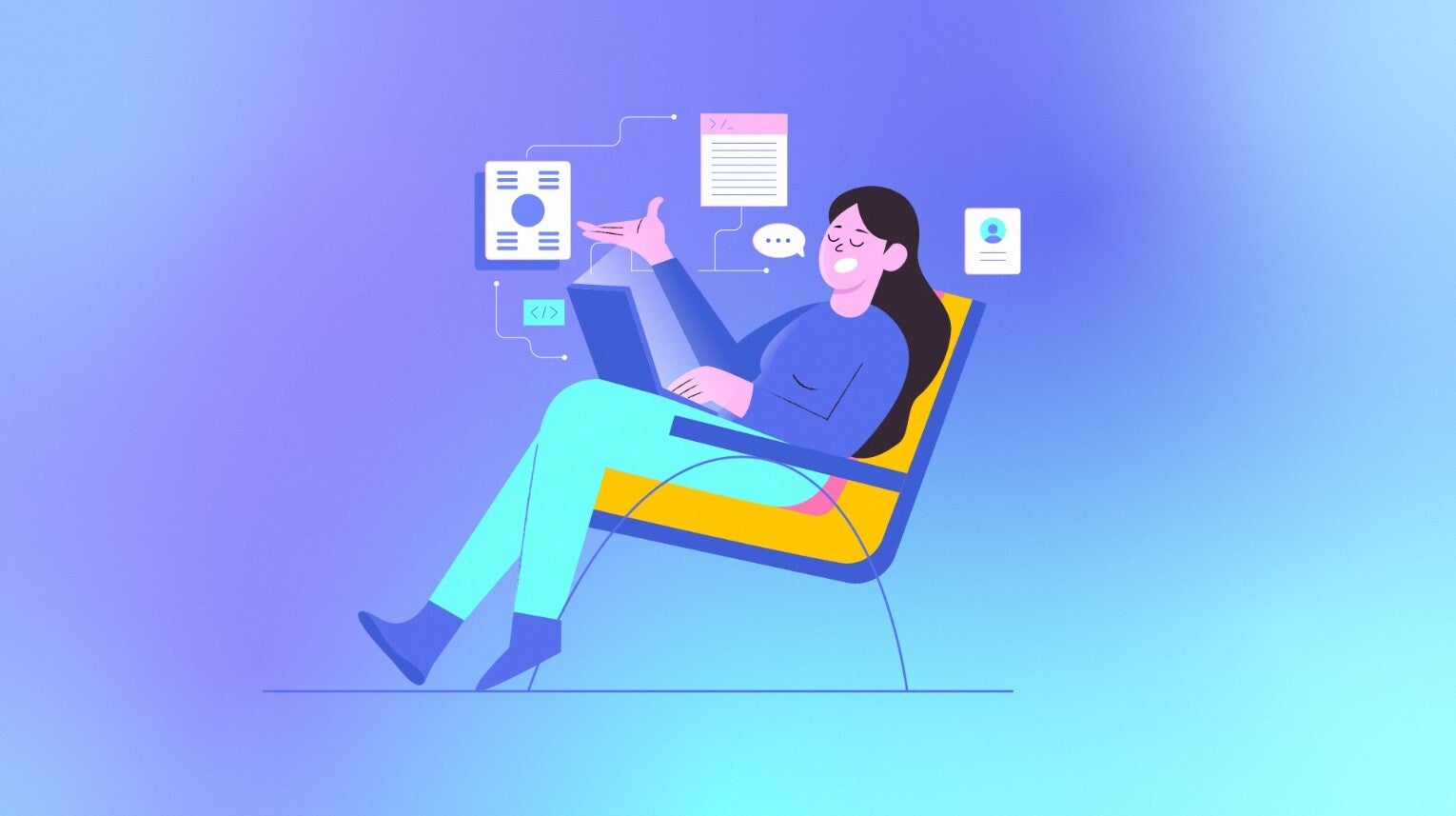
Minimal illustration of woman sitting on a chair. | Image by Microsoft
Being a tech enthusiast, I always have some interesting ideas running through my mind that I really want to convert into a dedicated app or a smartphone feature. I would really like to use vibe coding to create my own reminder app. It would offer more customization options than a smartphone’s default reminder app. For instance, I’d code it to only send me reminders when I reach a particular location at a particular time.
Other than this, I would also like to use this concept to customize certain UI behaviors on my Samsung smartphone. For instance, I would ask Galaxy AI to write code that would allow me to configure my device to turn on DND (Do Not Disturb) mode automatically whenever I open certain apps like YouTube or Netflix. The possibilities could be endless if vibe coding becomes a thing on Galaxy phones.
However, it could also invite some risks. For instance, installing a certain type of app or a feature created via vibe coding on the phone can cause security issues or affect the overall UI. But I am pretty certain that the South Korean giant will definitely keep this in mind whenever they actually introduce this concept in their phones.
That said, Won-Joon Choi didn’t mention when this feature could actually become live on Galaxy devices. But since it’s one of the hottest topics in the AI space, and the tech giant has started to consider its handhelds as AI phones rather than normal smartphones, the chances of the vibe coding feature actually coming to future Galaxy phones seem very high.
Contains information related to marketing campaigns of the user. These are shared with Google AdWords / Google Ads when the Google Ads and Google Analytics accounts are linked together.
90 days
__utma
ID used to identify users and sessions
2 years after last activity
__utmt
Used to monitor number of Google Analytics server requests
10 minutes
__utmb
Used to distinguish new sessions and visits. This cookie is set when the GA.js javascript library is loaded and there is no existing __utmb cookie. The cookie is updated every time data is sent to the Google Analytics server.
30 minutes after last activity
__utmc
Used only with old Urchin versions of Google Analytics and not with GA.js. Was used to distinguish between new sessions and visits at the end of a session.
End of session (browser)
__utmz
Contains information about the traffic source or campaign that directed user to the website. The cookie is set when the GA.js javascript is loaded and updated when data is sent to the Google Anaytics server
6 months after last activity
__utmv
Contains custom information set by the web developer via the _setCustomVar method in Google Analytics. This cookie is updated every time new data is sent to the Google Analytics server.
2 years after last activity
__utmx
Used to determine whether a user is included in an A / B or Multivariate test.
18 months
_ga
ID used to identify users
2 years
_gali
Used by Google Analytics to determine which links on a page are being clicked
30 seconds
_ga_
ID used to identify users
2 years
_gid
ID used to identify users for 24 hours after last activity
24 hours
_gat
Used to monitor number of Google Analytics server requests when using Google Tag Manager